

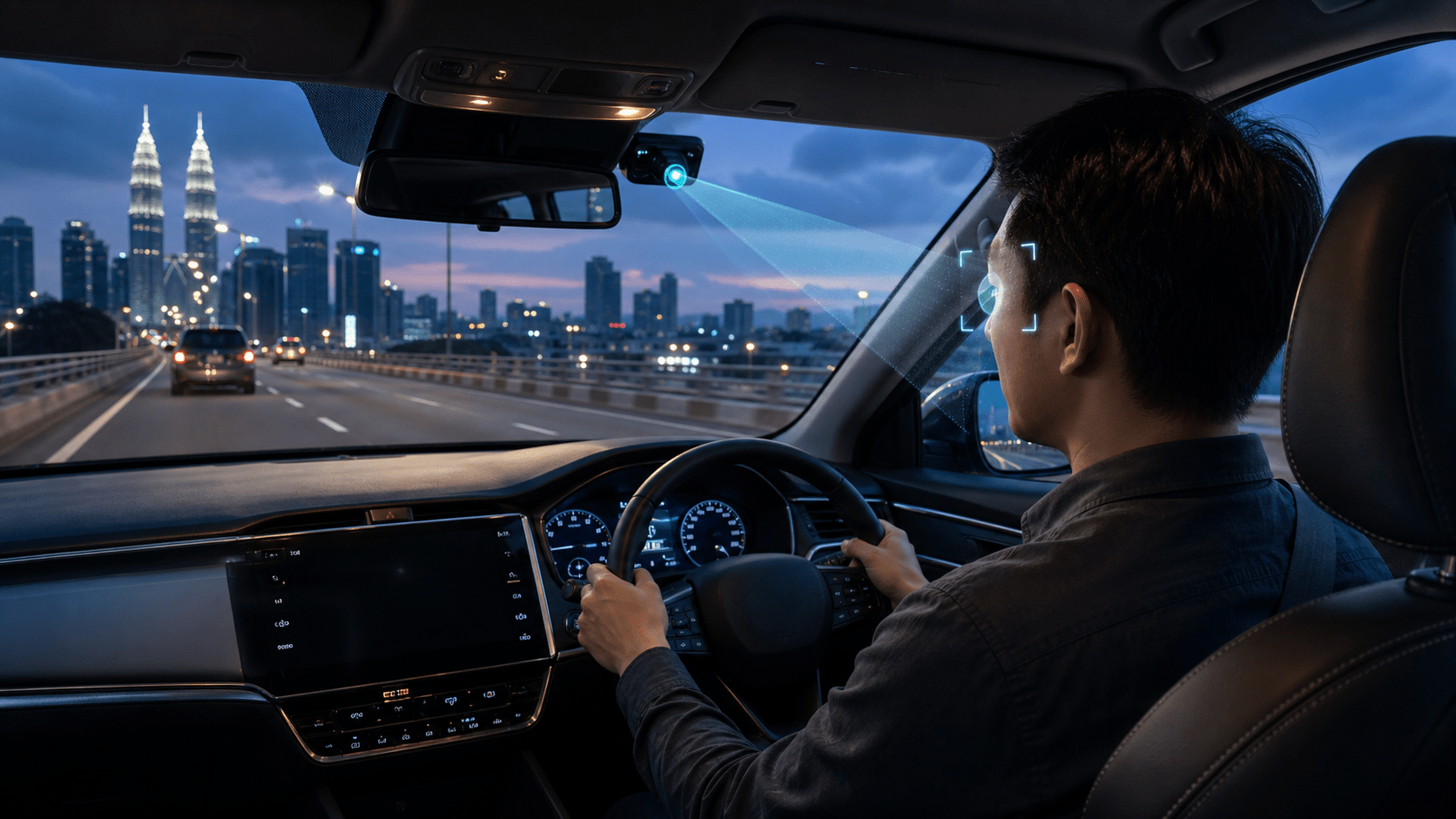
Imagine a quiet passenger sitting beside you every time you drive — one who never talks, never gets distracted, and whose only job is to watch your eyes. The moment you look away from the road too long, this passenger gently taps your shoulder. Since July 7, 2026, that “passenger” is no longer imaginary. It is now required equipment in every new car sold across the European Union.
The system is called an Advanced Driver Distraction Warning, or ADDW for short. A small infrared camera, usually tucked near the rearview mirror or dashboard, watches where the driver’s eyes and head are pointing. If you look away from the road for more than about 3.5 seconds while driving faster than 50 km/h — checking a phone, fiddling with the radio, or simply daydreaming — the car sounds an alert. At slower speeds, it gives you a little more time, about 6 seconds, before it speaks up. The rule already applied to newly designed car models since 2024; as of this month, it covers every new car, truck, and bus rolling off dealership lots across 27 countries.
Here is a simple way to picture what is happening under the hood. Think of a driving instructor sitting beside a learner driver, watching carefully and calling out “eyes on the road!” the moment attention drifts. ADDW is a tireless, robotic version of that instructor. It follows a simple recipe: watch the eyes, count the seconds, sound the alert if the count runs out. That is really all an algorithm is — a set of steps a computer follows every time, without getting bored, tired, or distracted itself.
Why should this matter to someone far from Europe, like us here in Miri? Two reasons. First, safety technology that becomes standard in one large market usually spreads to others within a few years, so today’s European requirement is a preview of tomorrow’s global default. Second, it is a clear, everyday example of AI moving off our screens and into the physical world around us — into cars, and soon perhaps into classrooms, workplaces, and homes.
That raises real questions worth sitting with. Would a machine watching your eyes every time you drive make you more careful, or would you simply learn to ignore the beeping after a while? Is there a difference between a person reminding you to pay attention and a machine doing it — and does that difference matter? If cameras start watching for distraction everywhere, what habit should we build in ourselves so we never actually need the reminder? And where else in daily life might a gentle AI reminder help us — or quietly make us lazier?
I have experienced how easily beautiful scenery can distract me while driving, and there were moments when that distraction nearly caused an accident. This reminded me that human attention is limited, even when we know we should stay focused. If technology can monitor danger, warn us early, and support safer habits, it can be extremely valuable. I believe the best technology helps us apply twenty percent of focused effort to achieve eighty percent of meaningful results. However, it should strengthen good habits, not encourage carelessness. The driver must remain responsible, alert, and ready to act at all times when necessary.
A machine can count the seconds your eyes leave the road. It cannot build the discipline that keeps them there in the first place. That part is still, and will likely always be, up to us.
 JOSIAH Miri