
There is a particular ache that comes when you look at the people around you and realise they are further ahead. A younger colleague completes his PhD. A friend launches a new business. Someone you grew up with gets promoted, published, or publicly recognised. And somewhere in the back of your mind, a quiet but persistent question begins to form:
What have I actually achieved?
I know that feeling well. I have sat with it longer than I care to admit.
The Comparison That Does Not Leave Quietly
Comparison is not always loud. Sometimes it arrives quietly, wearing the face of honest self-assessment. You are not exactly jealous of anyone. You just notice the distance between where you thought you would be and where you actually are. And the gap feels wider than it should.
I see people younger than me moving faster. In their careers, their studies, their businesses, their lives. And when I look at my own record, I struggle to name clearly what I have built in the same period.
That is difficult to sit with, especially when you carry the language of faith. You believe in God’s purposes. You trust in his timing. But in the quiet moments, you wonder whether you have confused divine patience with your own slow pace — or whether you have mistaken comfort for contentment.
I am not writing this from the other side of the struggle. I am writing from the middle of it.

Unfinished Is Not the Same as Wasted
Before I go further, I want to hold two things apart carefully, because I kept collapsing them into one.
There is a difference between a life that is unfinished and a life that is wasted.
A significant portion of my time and energy over the years went to my family. I do not regret that. My wife and children are not a distraction from my purpose — they are part of it. When I chose to be present with them, to invest time and attention that I could have spent elsewhere, I was not making a mistake. I still believe that.
But I also need to be honest about something else. There were seasons when I did not move slowly because of family. I moved slowly because of comfort. Because of distraction. Because I let procrastination take the lead. Because some bad habits sat too comfortably in my life for too long. I took the easier path more often than I should have, and I cannot attribute that to sacrifice or noble investment.
Both things are true at the same time. I invested in what mattered. I also lost time to what did not. That is my honest account of those years — not a defence, and not a full condemnation either.
The Weight of New Ambitions in an Old Rhythm
Here is where it gets harder. I now understand more clearly what I want to build. My Dream. A deeper knowledge of AI and engineering. Useful businesses. Real contribution to the people I teach, lead, and serve. A life that creates, honours God, develops others, and means something beyond my own comfort.
But the pace required for that kind of life is genuinely different from the pace I have been living. And I am still adjusting.
The old habits did not disappear when the new vision arrived. They did not step aside politely. Procrastination is still present. The pull toward comfort is still real. And on top of that, I am now carrying new responsibilities, new pressures, and new expectations from multiple directions at the same time.
The result is that I often delay, then chase deadlines in the final hours. The work gets done, but the cost is pressure, exhaustion, and a constant feeling of being behind. I do not want to live this way. But changing a rhythm built over years is not straightforward.
I sometimes feel suffocated by the accumulated weight of what is expected and what I want for myself. Some days I struggle to breathe under it.
What the Gospel Actually Said to Me
During this season, I came to understand the Gospel in a way that reached deeper than before.
This is not a testimony about everything turning around. The challenges I just described have not disappeared. But something changed in how I understand myself inside them.
The Gospel did not tell me that my procrastination was not real. It did not tell me that my bad habits were secretly fine, or that the time I spent passively was actually productive. The Gospel is not a rebranding of failure.
What it told me was this: God’s love for me is not earned through my output.
He does not love me more when I finish a chapter. He does not withdraw when I delay. The foundation of his relationship with me is not my productivity, my title, my PhD progress, my business record, or any version of visible achievement. I had intellectually understood this for years. But this season, it moved from my head into something more honest.
Romans 8:1 became very clear to me: “Therefore, there is now no condemnation for those who are in Christ Jesus.”
Not reduced condemnation. Not conditional acceptance. No condemnation. That is a declaration I had to read slowly and carefully before I believed it applied to a man still fighting old habits in the middle of an unfinished life.
Repentance is not the same as self-hatred. Acknowledging weakness is not the same as agreeing that you are worthless. I can face my procrastination, my slow pace, my poor habits, and my failures honestly — and I can do it without deciding that they define everything I am or everything I will be.
But the Gospel also refuses to be comfortable. Grace is not permission to remain passive. The same Saviour who says there is no condemnation also calls us to follow, to be faithful, to produce fruit. Peace does not mean avoiding responsibility. It means I can carry responsibility without being crushed by shame.
I can repent without collapsing. I can change without waiting until I feel fully ready. I can pursue meaningful work without making success my identity.
“Being confident of this, that he who began a good work in you will carry it on to completion until the day of Christ Jesus.”
Philippians 1:6 (NIV)
That verse does not promise me a fast career or guaranteed recognition. It promises completion. And it places the final responsibility for that completion in hands far stronger than mine, while leaving the daily choices clearly in my own.
A Foundation Is Meant to Be Built Upon
The years behind me contain both real investment and real loss. The teaching, the family years, the business attempts, the failures, the technical learning, the struggles, and the slow accumulation of experience — these are not nothing.
Experience has been laid. Perspective has been formed, often at real cost. Technical knowledge has grown. Relationships have been built. These things have value. They can serve as ground to build upon.
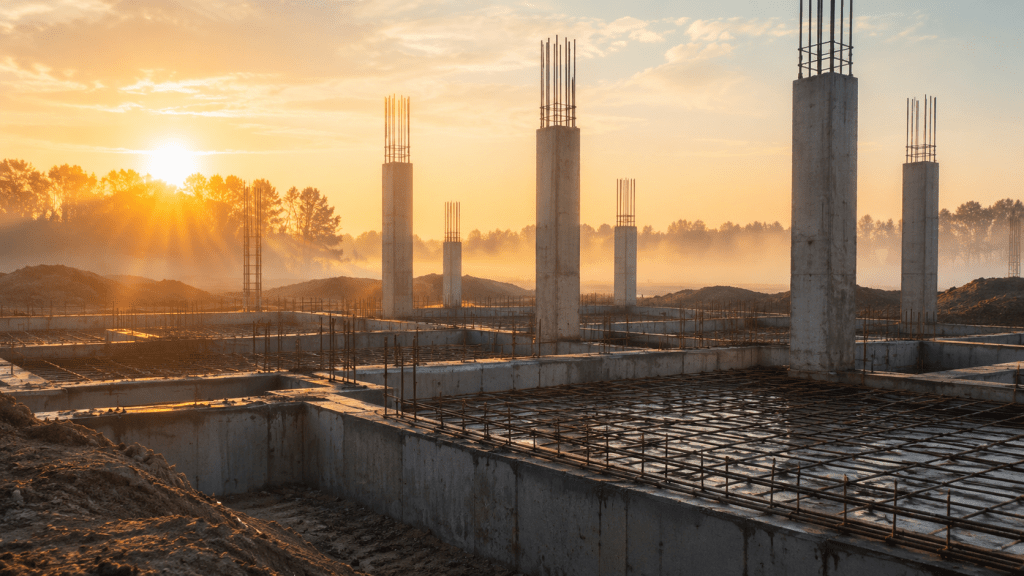
But a foundation is only useful if something is built on top of it. You cannot remain permanently in preparation. At some point, the planning must become execution, the reflection must become output, the intention must become completed work. A foundation that never supports a building is just concrete sitting unused in an empty lot.
I am at that point. The season of laying groundwork — some of it intentional, some of it accidental, some of it the natural result of life — must now support actual, visible, finished building.
That is not a dramatic transformation. It is a daily decision about how I spend the next hour.
What This Season Is Asking
If you are reading this and recognising something of your own life in these words, I want to leave you with a few honest questions. Not to add to the weight. Not to manufacture guilt where the Gospel has already spoken peace. But because clarity is where real movement begins.
What has this season revealed about you — not just about your circumstances, but about your habits, your choices, and the patterns you have allowed to continue?
What has God already placed in your hands that you have not yet used faithfully or brought to completion?
What specific habit is genuinely slowing you down, and are you willing to name it plainly without excusing it?
What is one piece of meaningful work you have been delaying — and what would it take to begin it within the next seven days?
These are not rhetorical questions. They are the questions I am sitting with myself.
The Grace to Build Today
I cannot undo the years already passed. I cannot rewrite my record, close the gap overnight, or pretend I have already mastered the discipline I am still learning. I am still adjusting. I am still fighting old patterns. I am still figuring out what a more faithful and more focused version of my daily life actually looks like.
But I am not condemned. I am not abandoned. I am not too far behind for something meaningful to be built.
My life is unfinished, not wasted. The grace that covers my failures is the same grace that gives me the courage to face them honestly and continue forward.
I cannot rewrite yesterday. But by the grace of God, I can decide what I will build today.
 JOSIAH Miri