
This is a fictional continuation inspired by Luke 15:11–32. It is not an addition to Scripture, and makes no claim to biblical authority. It is a story written to invite reflection.
Part One: The Feast
The fields were dark when Eliam came home.

He had been out since before sunrise — clearing stones from the eastern boundary, directing the hired men through the dry channels where the irrigation needed repair. His sandals were caked with earth. His robe was stiff with sweat and dust. His hands ached in the particular way they always ached in the evening, a deep soreness that sat in the joints of his fingers and reminded him, every night, that the work had been real.
He liked that ache. It was proof.
He was still three hundred paces from the house when he heard it.
Music.
Not the distant hum of servants at their evening tasks. Not the low murmur of his father speaking with the steward on the porch. This was full music — the tambourine, the pipe, the sound of voices raised in a way that could only mean one thing.
Celebration.
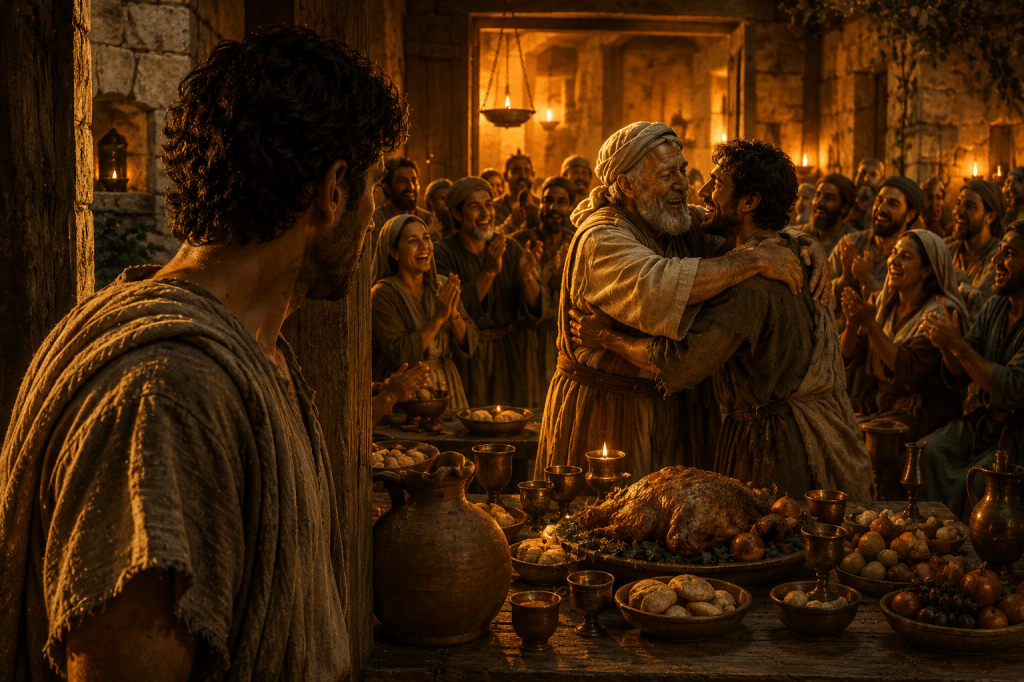
Eliam stopped walking. He stood in the dark between the fields and the house and listened. Light spilled from every window. Torches had been set in the courtyard. Even from this distance he could smell the fire and the meat.
The fattened calf.
He knew that smell.
A servant boy came running past and Eliam caught him by the shoulder.
“What is happening?”
The boy was breathless and wide-eyed, as though the evening itself was an unexpected gift. “Your brother, sir. He has come home. Your father — your father has killed the fattened calf and called everyone to eat. He says your brother was dead and is alive again. That he was lost and is found.”
Eliam released the boy.
He stood for a long time in the dark.
His brother.
He had imagined this moment. Dozens of times, alone in the fields or lying awake through the heat of summer nights, he had imagined Davan returning. He had imagined him thin, hollow-cheeked, head bowed — returning the way a man returns when the world has finished with him. He had imagined the conversation. He had imagined himself speaking firmly, perhaps even generously, about what forgiveness required. He had imagined a quiet, measured welcome, proportioned carefully to reflect both mercy and wisdom.
He had never imagined music.
He had never imagined the fattened calf.
He did not go inside.
He stood in the courtyard while the torchlight moved and the celebration continued and the voices of his father’s household rose and fell around him. And when his father came out — as he had known his father would — Eliam did not look up.
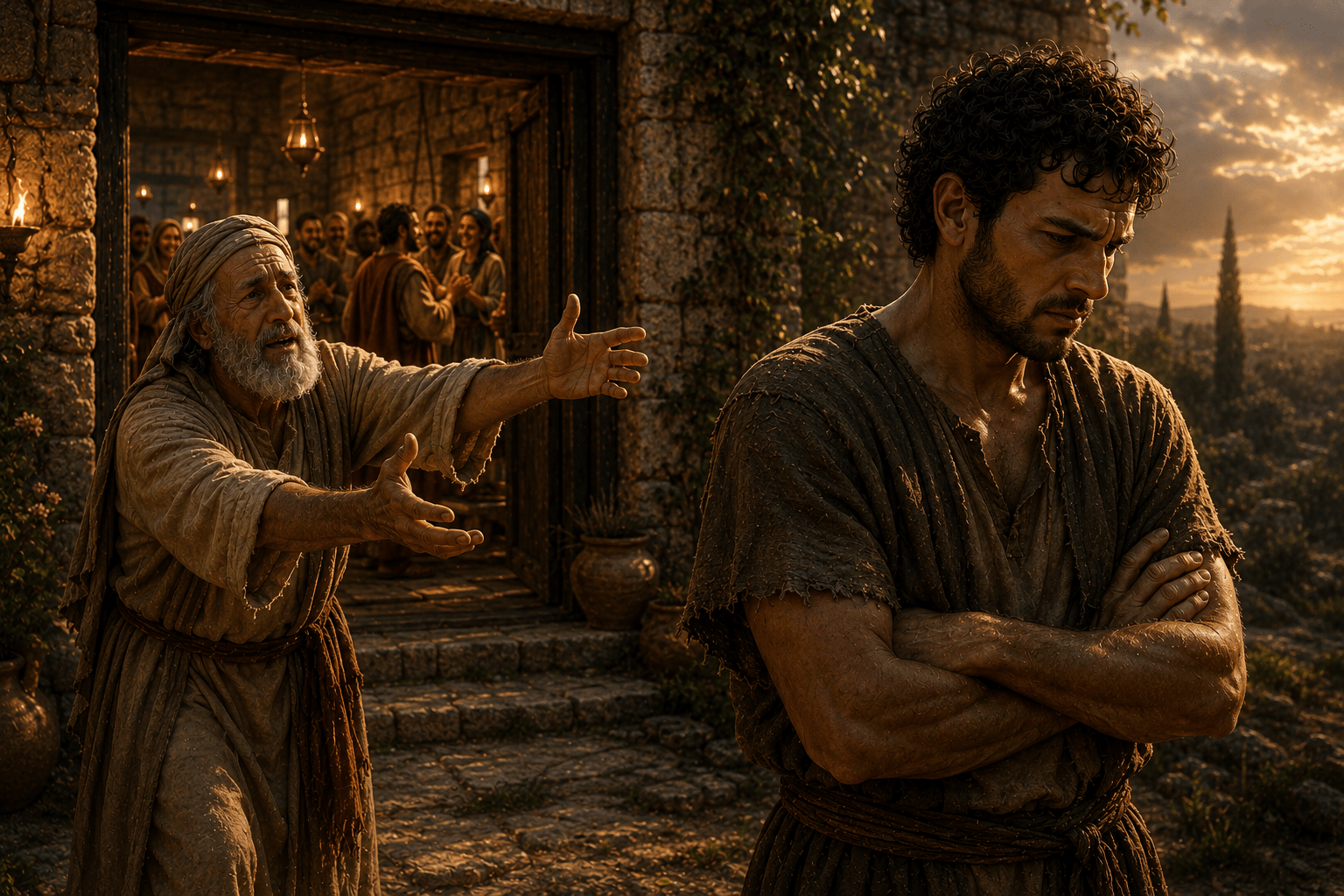
“Your brother is home,” his father said. There was something in his voice that Eliam had not heard in years. Something loosened and bright.
“I know.”
“Will you not come inside?”
“I have served you.” The words came out before Eliam had chosen them, which surprised him. He had not planned to say that. But once it had been said, more followed, and he could not stop them. “I have been here every day. Every season. Every dry year and every flood. I never left. I never demanded anything from you before the time. And in all those years, you never once killed a calf for me. You never gave me even a young goat so I could celebrate with my friends.” He paused. He could hear the music from inside the house. “But when he came back — after wasting everything you gave him, after living in ways that shame our family name — you killed the fattened calf for him.”
His father stood quietly. He did not rush to answer. He never did.
“My son,” he said finally. “You have always been with me. Everything I have is yours. It always has been.”
“Then where was my feast?”
The question hung in the warm night air. Behind them, someone inside the house laughed, and the tambourine struck a bright note.
His father reached out and touched Eliam’s arm. “Come inside.”
Eliam looked at the house. At the light. At his father’s hand on his sleeve.
He pulled away.
That night, one son returned home. The other began to leave.
Part Two: The Son Who Remained Outside
Eliam did not leave the estate.
He rose the next morning before the household, as he always had, and went to the fields before the sun was fully over the hill. He returned the equipment to the storehouse. He inspected the east boundary. He reviewed accounts with the steward. He did what he had always done, and he did it without being asked, and no one thanked him for it because no one had ever thanked him for it, and that, he told himself, was the whole point.
He did not eat with the family.
He said he was tired. The first time, it was almost true.
The second time, it was a choice.
After that, it required no deliberation at all.
He watched Davan from a distance. He watched his brother receive back the robe, the ring, the sandals on his feet — all the visible signs of restored position. He watched his brother sit at the table where their father sat. He watched servants bring his brother water, bread, fruit, as though he had never left, as though the inheritance had never been demanded and squandered, as though the family name had never been carried into foreign towns and dirty establishments where no son of this household should ever have gone.
The ring was the worst of it.
Every time Eliam saw that ring on his brother’s hand, something tightened in his chest that he could not name clearly and did not want to examine closely.
Davan came to him, one afternoon, near the old fig tree at the edge of the lower terrace.
“Eliam.”
Eliam kept working. He was checking the stone wall where it had crumbled through the rainy season.
“I wanted to speak with you.”
“I am busy.”
“I know.” Davan stood for a moment in the way he had stood as a child when he had broken something and needed to confess it. There was shame in how he held himself, and something else — a quietness that had not been there before. “What I did was wrong. To Father. To our family. To you. I know that what I took from Father, I took from you also. I am not asking you to pretend it did not happen. I am only asking—”
“Why did you come back?”
Davan blinked.
“Tell me the truth,” Eliam said. “Not the speech you rehearsed. The actual reason.”
A pause. “Because I had nowhere else to go. I was starving.”
“Yes.” Eliam set down his tool and looked at his brother for the first time in several weeks. “That is what I thought.”
He walked away. He did not look back at the hurt on Davan’s face.
He told himself he had done nothing wrong. He had only asked for the truth. He had only confirmed what he already knew. But that night, alone, the memory of Davan’s expression returned to him uninvited, and Eliam found that he was not as comfortable with it as he had expected to be.
He pushed it away. He was tired. He had been working all day. He had earned the right to sleep.
Part Three: Obedience Without Love
The seasons turned.
Eliam worked harder.
He expanded the orchard. He hired three more men. He renegotiated contracts with the traders who came through in the spring. He rose earlier and retired later and accomplished more than any manager his father had ever employed — more than his father himself had managed in comparable years.
He was meticulous with the servants. Wages were paid according to performance, measured carefully, adjusted regularly. Rest was permitted at the appointed intervals and no more. He was not cruel. He simply did not allow sentiment to interfere with structure.
His father came to him in the late afternoon one day when the heat had not yet broken and found Eliam still at his accounts.
“Come and walk with me,” his father said.
“I am not finished.”
“You are never finished.” His father sat down across from him. “When did you last sit by the river?”
Eliam dipped his pen. “I do not remember.”
“Eliam.”
“Father.”
There was a long silence. The dust moved slowly in the shaft of light through the window.
“You are exhausted,” his father said.
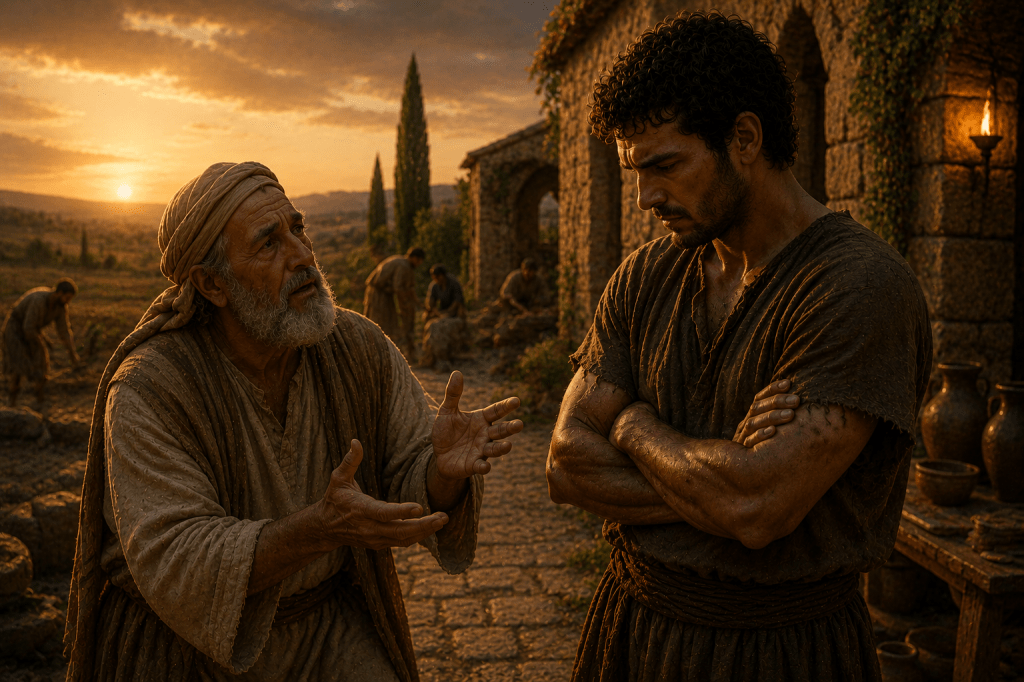
“I am productive.”
“Those are not the same thing.”
“No. But one of them matters here.”
His father studied him for a long moment. “Sit with me tonight. After the evening meal.”
“I will not be hungry.”
“I am not asking you to eat. I am asking you to sit with me.”
Eliam put down his pen. He looked at his father’s face — older than he remembered it being, the lines deeper, the eyes still patient but carrying something they had not always carried. A grief, perhaps. Something unresolved.
“You gave him mercy,” Eliam said quietly. “You gave me work.”
“I gave both of you my love.”
“That is not the same as what you gave him.”
“Mercy toward your brother was never a rejection of you. It was not taken from you to be given to him. That is not how love functions.”
“Then explain to me,” Eliam said, his voice controlled and flat, “why I have worked every day for twenty years and have never once been celebrated the way he was celebrated for simply returning after failing.”
“Because you were not lost.”
“How would you know?” The words came out harder than he intended. He returned to his accounts. “How would anyone know?”
His father rose slowly. At the door he stopped.
“You are not my servant, Eliam.”
Eliam did not look up from the page. “That is all I have ever been.”
A long pause.
“No,” his father said. “That is what you have chosen to become.”
Part Four: The Second Demand
Three years after Davan’s return, Eliam came to his father on the morning of the spring planting.
“I want my share of what remains.”
His father was still. “What remains?”
“The eastern property. The lower orchards. Whatever portion of the estate would fall to me. I want to take it and build my own place. Away from here.”
The resemblance to his brother’s original demand was not lost on either of them. Eliam saw it register on his father’s face — not anger, but something more painful than anger. Recognition.
“You already have it,” his father said. “I promised it to you years ago. You have always known it would be yours.”
“I want to use it now.”
“Why?”
“Because I am forty-one years old and I have spent my whole life building something that is not mine, in a house where I do not belong, for a family that—” He stopped. He was breathing harder than he expected. “I will build my own estate. One where what a man earns is what a man receives. Where there is order. Where faithfulness is actually rewarded.”
“You already have a place at this table.”
“I do not want a place at this table.”
“You have the family name.”
“A name I have spent my whole life trying to prove worthy of.”
His father was quiet for a long moment. The morning light was on his face.
“Most importantly,” his father said, “you have me.”
Eliam looked at him. There were many things in his chest at that moment. He could not sort them.
“It was not enough,” he said.
He heard himself say it. He felt it land between them.
His father’s face did not collapse. It was something worse — a quiet sorrow, deep and dignified, that did not flinch.
Davan found Eliam at the gate, loading the last of his belongings.
“Please,” Davan said. “Stay.”
Eliam tightened the rope on his pack. “You do not understand.”
“I understand more than you believe I do.”
“We are not the same, Davan. What happened to you and what is happening to me are entirely different.”
Davan stood for a moment. He looked at his ring. Then he looked at his brother.
“I once believed that too,” he said.
Eliam went out through the gate.
Part Five: The Far Country of Achievement
The estate Eliam built was, by any measure, impressive.
The walls were high and well-mortared. The gates were strong, made from timber seasoned in the eastern mountains. The fields were managed precisely, the irrigation channels kept clear, the harvest predictably large. Within five years his name was known in every trading town within a day’s journey. Men came to him with proposals. Buyers trusted him because he kept his word. Workers stayed because his wages were fair, and if they feared him slightly, they respected him enormously.
He did not allow music in the halls.
There was no reason for it.
Celebration, he had concluded, rewarded events that could not be controlled. He preferred to reward decisions that could be.
The house was quiet. The servants moved efficiently and spoke carefully. He took his meals alone, which suited him, because meals were for sustenance rather than sentiment. There was no wife. There had been a possibility, years ago, but she had eventually told him that living with him felt like working for him, and had gone elsewhere.
He found he did not miss her company as much as he missed the idea of what company might have been.
His father’s letters came every few months.
My son. The door remains open.
Your brother has not replaced you. No one has replaced you.
I watched you load your pack at the gate. I have watched that gate every morning since.
You have spent your life trying to earn what was already yours. I wonder if you know how deeply it hurts me to watch you do it.
I do not want your wealth. I do not want your success. I want my son.
At first, Eliam read the letters twice.
Then once.
Then he filed them in the cedarwood chest near his window without reading them at all.
Then he stopped opening them.
Part Six: The Father at the Gate
The old man arrived on a morning when the sky was the colour of pale clay.
Eliam’s gatekeeper came to him while he was reviewing the spring accounts and said that an elderly man was at the gate, asking to see the master of the estate. The gatekeeper said the old man had walked some distance and was resting against the outer wall.
Eliam knew before he reached the gate.
He went himself, which he rarely did. He opened the wicket but not the main gate.
His father was older. He had always been old to Eliam, but now he was old in a different way — the way that is not merely years but accumulated loss. He was leaning on a staff he had not carried when Eliam left. But his eyes were the same. Clear. Patient. Unguarded.
“My son.”
“Father.” Eliam gripped the edge of the gate. “You should not have walked so far.”
“No distance is too far.”
“You should go back.”
“Not without you.”
They stood on opposite sides of the gate. Inside, the estate was quiet and ordered. Outside, his father stood in the road in the morning light, older and smaller than Eliam remembered, waiting with the patient persistence that had always, always characterised him.
“You have built something significant,” his father said, looking at the high walls.
“Yes.”
“Does it sit beside you when you are lonely?”
Eliam said nothing.
“Does it call you beloved when you fail?”
“I do not fail.”
“Everyone fails, Eliam. The question is whether there is someone who loves you through it.”
“I have managed without—”
“Does it permit you to rest?”
The word rest struck somewhere Eliam had walled off carefully. He set his jaw.
His father reached through the bars of the gate. His hand — thin now, the knuckles more prominent than Eliam remembered — extended toward him in the space between the iron posts.
Eliam looked at that hand.
He took a slow breath. Then he stepped back from the gate.
“Go home, Father.”
His father held his hand in the empty air for a moment longer. Then he lowered it. He did not argue. He did not plead. He simply looked at his son with the expression of a man who has chosen to love someone who is refusing to be loved, and who intends to keep choosing it anyway.
“I will come again,” he said.
He did. Every season, for three years, the old man came and stood at the outer gate and asked to see his son, and every time Eliam came to the wicket and every time they spoke and every time, eventually, the gate remained shut.
Until the winter.
The Branching: A Winter and Two Roads
The winter came without warning, the way disasters often do when a man has constructed his life around the belief that he can prevent them.
The frost arrived early and stayed late. The river froze above the irrigation intake. Three consecutive weeks of bitter cold killed the lower orchard and cracked the storage jars where the olive oil was kept. Two of his best workers left to find employment in the southern towns. The traders stopped travelling. The accounts, which had always been a source of steady satisfaction, became a source of a different kind of attention.
For the first time in fifteen years, Eliam could not see a clear way forward.
He sat alone in his quiet hall and listened to the silence of the estate around him and understood, for the first time, that silence and emptiness are not the same thing — but that he had confused them for a very long time.
Ending One: The Son Who Would Not Enter
His father heard.
He came before the worst of it, but only just. He came with Davan, and with two servants carrying food and blankets and medicine, and they stood at the gate in the early morning and knocked.
They had to break through.
The gatekeeper was gone. The gate was frozen and the lock had seized and the two servants worked at it while Eliam’s father stood and waited in the cold.
They found Eliam in the hall. He was not dying. But he was not well. The cold had gotten into him, and the failure of the harvest had gotten into him more deeply than the cold.
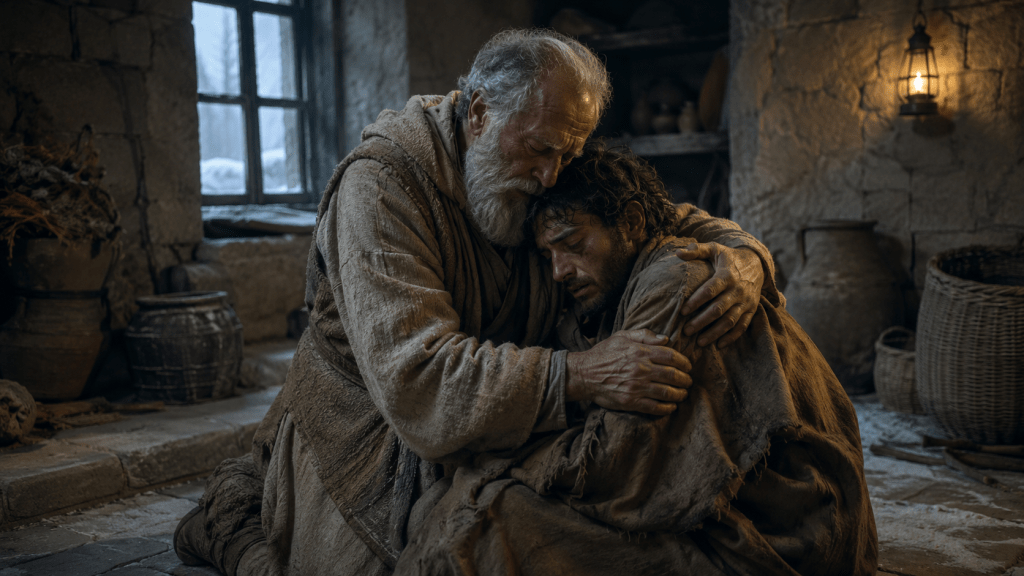
His father crossed the room and knelt beside him and put his arms around him the way he had once embraced Davan in the road.
“Come home,” he said. “Come home, my son.”
Eliam looked up.
Davan was standing in the doorway.
The ring was on his hand.
It was the ring that did it. Even now. Even here, with his father’s arms around him and the warmth of another body against the cold and the relief of not being alone — even now, the ring undid something that had almost, almost opened.
“I will not go back,” Eliam said, “to live under the same roof as him.”
“Eliam—”
“I will not sit at the same table. I will not eat the same bread.”
“My son. Listen to me.” His father’s voice was low and steady. “Mercy is not the reward of the better son. It is not the prize for the one who sinned less. It is the only way any son comes home. It is the only way you can come home.”
“I do not need the same mercy he needed. I did not do what he did.”
“No. You did something different. And you need the same mercy.”
“Your chair is still there,” his father said. “It has always been there. It has been empty because you refused to sit in it. Come home and sit in it.”
Eliam looked at his father. He looked at the hall he had built — the high ceiling, the cold hearth, the ledgers on the table. The silence.
He looked at Davan in the doorway.
“We are not the same,” he said again. His voice was very quiet now. “We will never be the same.”
“You are both my sons,” his father said. “That is what you are.”
Eliam closed his eyes.
He did not come home.
He died three days later, in his father’s arms, with the warmth of his father’s embrace around him and the refusal still in his chest, hard as the frozen ground outside.
His father wept over him. Not as a man betrayed, but as a man who had loved fully and lost — not through any failure of love, but through the impenetrable will of a son who had decided, at some point so long ago he could no longer find it, that he would not need anyone.
They carried him home.
There was no feast.
That evening, in the large room where the family had always gathered, there were two chairs at the table. One was occupied. One was not.
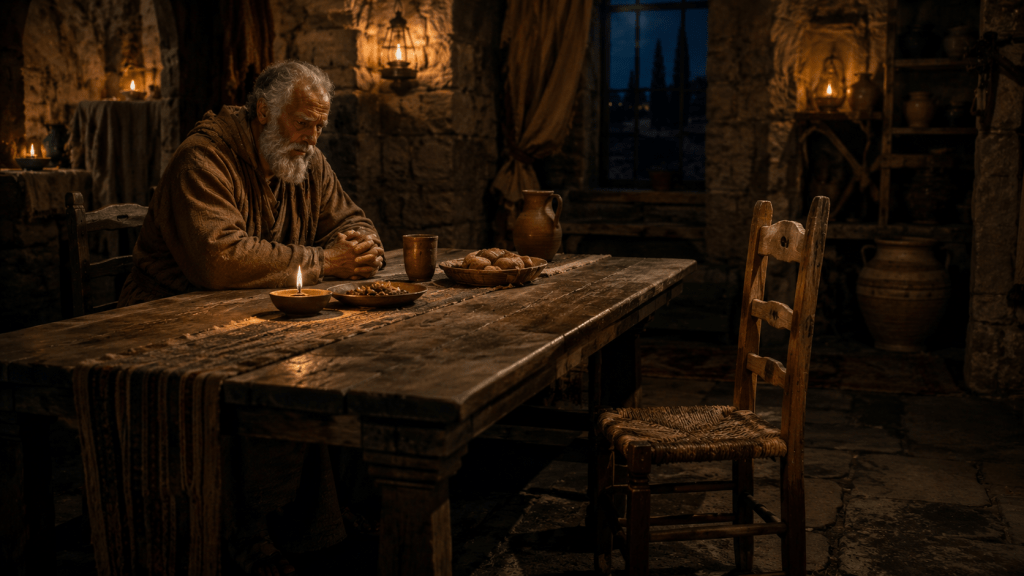
The younger son had nearly lost his life through rebellion and found his way home. The eldest son had built a life through pride and would not be led through the same door. The father’s love had reached both sons, with the same hands, across the same distance. One received it. The other refused to need it. And a love that will not be received cannot do what it was meant to do — not because it is insufficient, but because love does not break down the door of a will that has been finally, irrevocably, shut from the inside.
Ending Two: The Son Who Finally Entered
The storm had been going for two days when Eliam, cold and unable to sleep, finally opened the cedar chest.
He had not intended to. He had gone to the chest for a blanket. But when he lifted the lid, the letters were there — years of them, bundled loosely, his father’s handwriting on each. He picked up the top one, the most recent. He opened it without deciding to.
I was never waiting for your success. I was waiting for you.
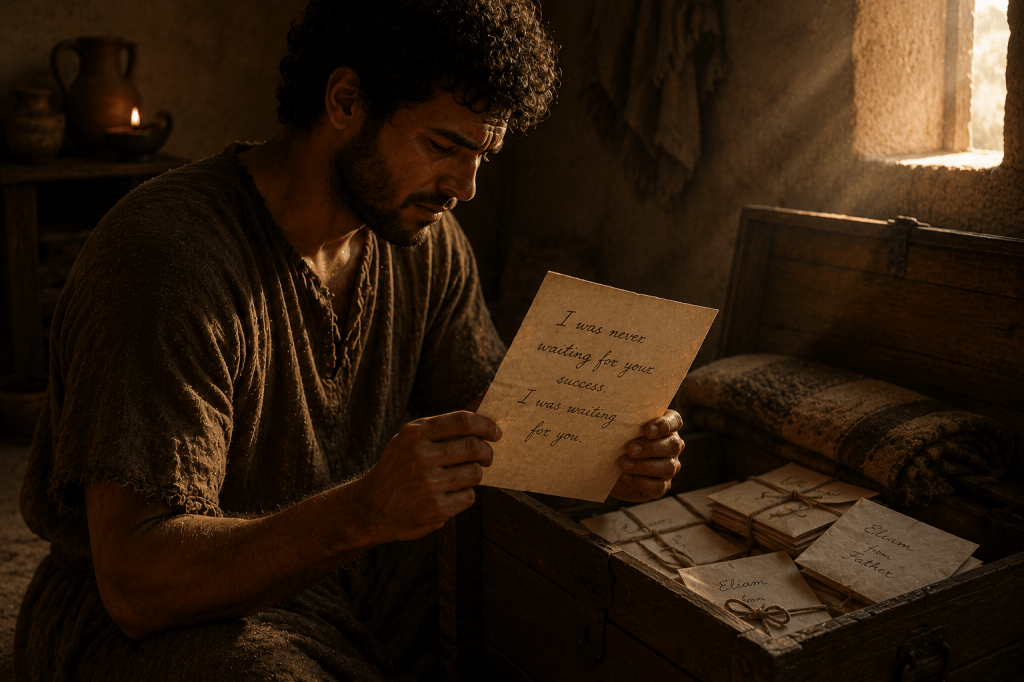
He read it again. And again.
He began to read the others. He read them in the wrong order, pulling them out at random, reading fragments from different seasons — a line from three years ago, a paragraph from the year he first built the gate, a closing from the last visit. In all of them the same thing: a door that remained open. An invitation that did not expire. A father who had not moved on to loving some other son.
Eliam sat in the cold hall for a long time.
He thought about Davan, who had gone to a distant country looking for life and found slavery.
He thought about himself — who had stayed, or believed he had stayed — building something controlled and correct, a world constructed on the premise that a man’s worth was the sum of his accomplishments.
He thought about the ring.
He thought about what the ring actually meant — which was not that his brother deserved restoration, but that the father’s capacity for restoration was greater than the sum of any son’s failures.
He had gone to a distant country too. He had simply built it inside himself and then moved into it, and walled it, and told himself it was an achievement.
He left before dawn.
He took nothing that he had built there. He did not arrange for the estate. He did not write to the traders. He walked away from the high walls and the locked gates and the silent hall and the ordered world where everyone received exactly what they had earned, and he walked the road that he knew from forty years ago, and he walked it for two days in the cold.
On the morning of the third day he saw his father’s estate on the hill.
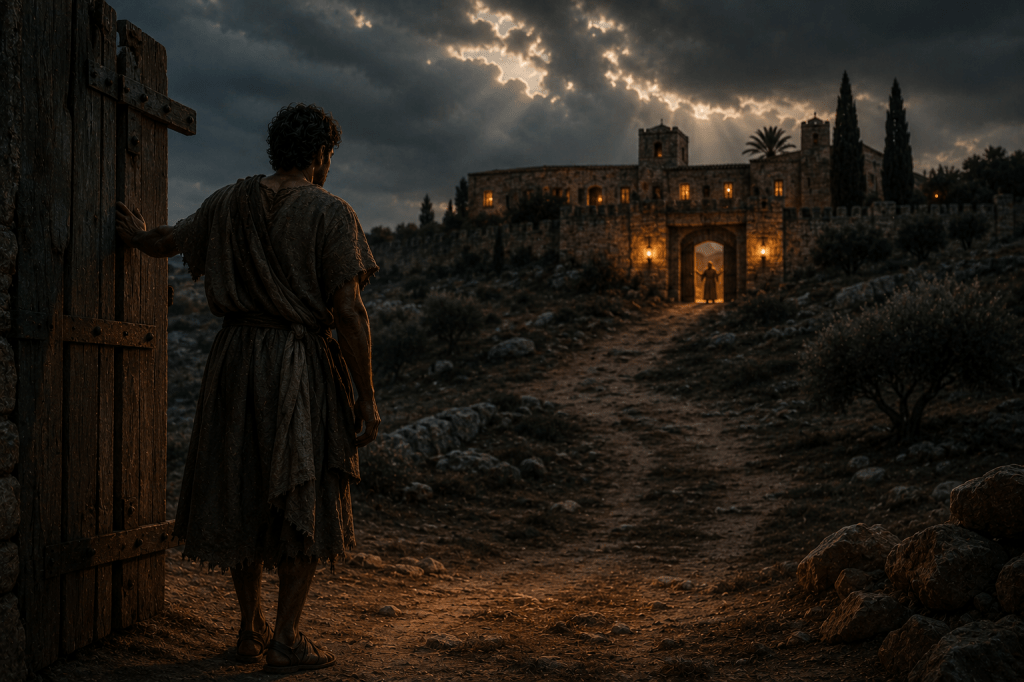
A lamp was burning at the gate. Not because it was dark — the sun was rising. The lamp had been burning all night.
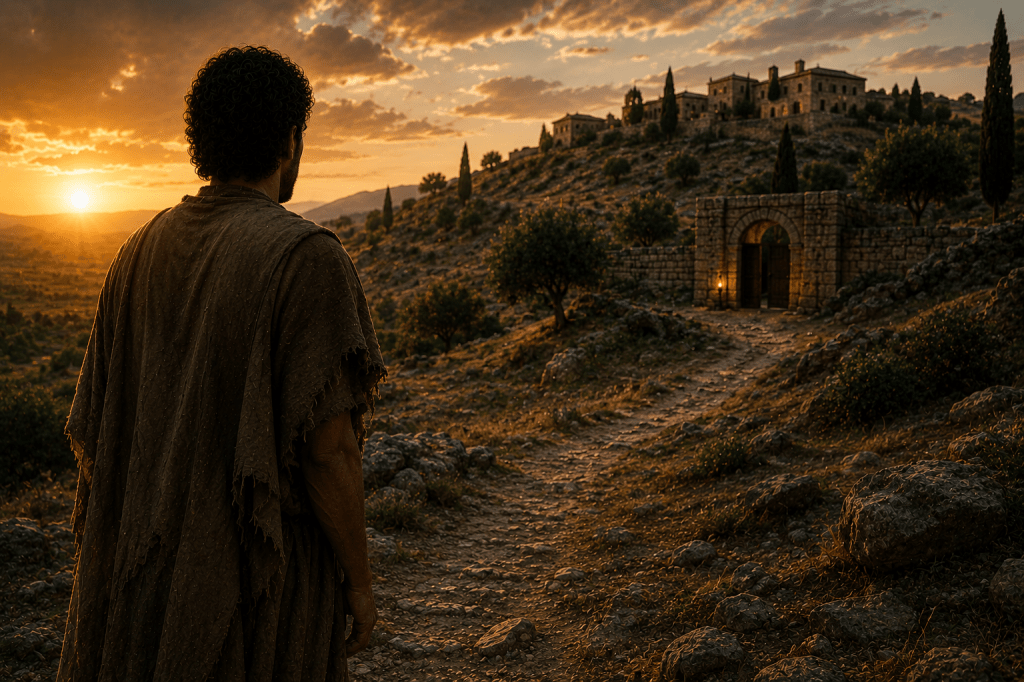
He was still a long way off when he saw the figure at the gate move. Then run.
The old man should not have been running. He was too old to run. But he ran anyway, down the path from the gate, his robe gathered in his hands, in the same way he had once run down a dusty road to meet another son who had come home ashamed.
His father took him in his arms and Eliam, who had not wept since he was a child, wept.
“Father. I have served you as though I were your servant, not your son. I have stood outside what was already mine and called it fairness. I have—”
“Hush,” his father said. “Hush.”
“I want to ask you — let me serve you. As a hired man. I will earn my way back. I can—”
His father stepped back and held him by the shoulders and looked at him with an expression that silenced everything.
“I have enough servants,” he said. “I want my son.”
They went inside.
Davan was in the courtyard.
The brothers stood across from each other. Years of distance. Years of resentment and shame and refusal. The ring was on Davan’s hand and this time Eliam looked at it without the tightening in his chest — or perhaps with it, but without surrendering to it.
“I am sorry,” Davan said. “For the inheritance. For leaving. For what it cost you and Father. I have not stopped knowing what I did.”
Eliam was quiet for a long moment.
“I owed you an apology long before this,” he said. “At the fig tree. I heard your confession and I used it against you. That was not the act of a brother.”
Neither of them pretended. They did not embrace immediately or speak words that dissolved the years. But they stood together in the courtyard in the morning light, two men who had both wandered into far countries by different roads, and neither of them looked away.
Their father was watching from the doorway.
“Will you come inside?” he asked.
It was the same question he had asked fifteen years ago in the torchlight, at the first feast. At the gate of the cold estate. Every time.
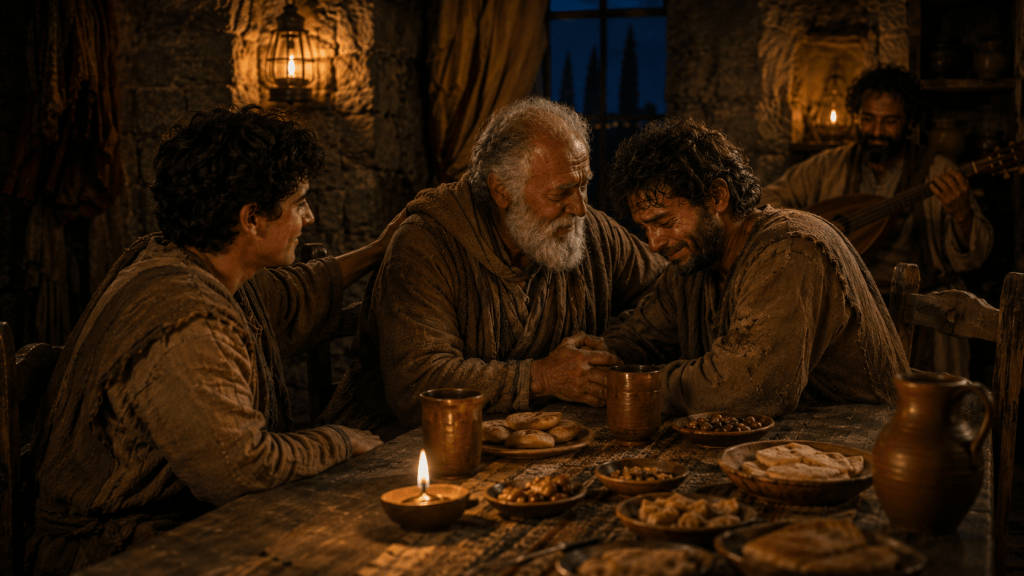
This time, Eliam went through the door.
Somewhere in the house, someone began to play.
He did not recognise the song at first. Then he did. It was the same music he had heard the night he stood outside in the dark with the ache in his hands and the dust on his robe — the night he had decided he would not go in.
He sat down at the table.
His chair was there. It had always been there.
His father sat beside him. Davan sat across.
The younger son had once believed that freedom without the father was life, and had found it was slavery.
The eldest son had once believed that obedience without love was faithfulness, and had found it was also slavery.
One son had returned from a distant country.
The other had returned from a distant country that lived inside his own chest.
Grace was not the reward of the better son.
Grace was the heart of the father.
Which Son Are We Becoming?
Jesus ended the parable without telling us what the eldest son decided. Perhaps that silence is intentional. Perhaps it is because the story is not finished. Perhaps it continues in us.
Before you read further, sit with these questions honestly:
Am I serving God from love, or have I slowly begun serving Him to earn something — security, significance, a sense that He owes me for my faithfulness?
When I see someone receive grace after making choices I would never have made, do I feel genuinely glad? Or does something tighten in me that I prefer not to examine?
Have I confused exhaustion with holiness? Do I believe that rest, celebration, or receiving kindness is a kind of weakness?
Do I still call God “Father,” or have I quietly begun relating to Him as an employer — performing, accounting, calculating?
Is there someone in my life whose restoration I have refused to celebrate? Someone whose ring I cannot look at without resentment?
Have I remained in the Father’s house while withdrawing my heart from it — present in the practices of faith, but distant in my affection?
Am I willing to receive the same mercy I believe others need? Not as a theological abstraction, but as an actual, personal, humbling act of surrender?
The eldest son’s danger was not his faithfulness. Faithfulness is right and good. His danger was that his faithfulness became the lens through which he measured love — and love cannot be measured that way without becoming something else entirely.
The Father’s arms are not extended because we have arrived in perfect condition. They are extended because we are His. That has always been the truth. The invitation has not changed.
Come inside.
A Closing Invitation
Take ten quiet minutes today with Luke 15:11–32.
Read it slowly. Do not rush past the eldest son. Do not assume he is a minor character or a footnote.
Look for him in yourself, little Christian that serve in Church. Not in the dramatic, obvious rebellion of the younger son — that is easy to identify and disown. Look for him in the weariness. In the scorekeeping. In the moment you pulled your arm away from the Father’s hand because you had decided, without fully realising it, that His love was not enough.
Then pray honestly. Not a polished prayer. An honest one.
About resentment. About exhaustion. About comparison. About the part of you that has been standing outside the feast, in the dark, telling yourself you are too tired or too wronged or too proud to walk through the door.
The lamp is still burning at the gate.
The Father has not gone to sleep.
 JOSIAH Miri